
|
GLOB
Nitrogen gain and loss in changing coastal lagoon ecosystems of the Baltic Sea |


|
Project description
AbstractEstuarine systems, being situated at the interface between land and marine environments, are potentially important sites for nitrogen (N) turnover due to long water retention time and high rates of biogeochemical processes. The estuarine systems receive significant nutrient and organic matter loads via riverine inputs from their surrounding catchment. It has been posited that much of the received material within the estuarine systems can be retained and removed through pelagic and sedimentary biogeochemical processes. As a result, estuarine systems are perceived as coastal filters that play an essential role in regulating nutrient delivery to adjacent coastal areas. Despite their relatively low number, estuarine systems account for nearly 50% of coastal surfaces in the Baltic Sea. Among estuarine systems, the coastal lagoon is most dominant, receiving varying amounts of nutrients seasonally, especially N. However, most river-dominated lagoons shift toward N limitation in summer, creating favourable conditions for opportunistic microorganisms capable of fixing dissolved dinitrogen (N2). Additionally, sediments during summer can release a substantial amount of the previously fixed and transformed N. However, the entity of internal nutrient loading during summer in lagoons remains to be discovered on the global scale. Despite our increasing understanding of nutrient delivery pathways to estuaries in general and to the lagoons in particular, the input mechanisms of new N via biological fixations or sediments release, or its loss via dissimilatory pathways, still needs to be identified.
Today, all estuarine systems are undergoing profound changes as benthic animals, including invertebrates, are harvested and key habitats are lost, degraded or expanded due to ongoing climate change and human interventions. Any shift in ecosystem functions in sediment or water column could indicate a response to changes in nutrient cycling and microbial communities. Consequently, the dominant pathway for nutrient cycling may be lost or become redundant for ecosystem functioning. Therefore, we urgently need to revise our understanding of estuarine system functionality. A concerning recent trend is marine heat waves, which can cause high thermal stress on pelagic and benthic habitats and strongly influence biogeochemical processes within estuarine systems, impacting their ecological capacity to transform nutrients. Knowledge about the occurrence of heat waves in the Baltic Sea in upcoming years is limited. According to literature, warm sea surface temperature days (SST) and the record-breaking anomalies of summer will likely become more common in the future. Evaluating the effects of thermal changes caused by climate warming and, more often, heat waves on the shallow estuarine systems is highly desirable. Nevertheless, our understanding of estuaries' functioning and their role in nutrient attenuation or gain across different systems remains limited. The project aims to develop a fundamental knowledge base on the functional role of estuarine systems in N gain and retention, and how these ecosystem functions respond to recurring heatwaves in shallow vulnerable lagoons (Curonian and Vistula Lagoon) located around the Baltic Sea.
These coastal areas were selected because
1) they have the potential to attenuate loads to the Baltic Sea, and
2) lagoons are experiencing rapid ongoing changes that impact the diversity of micro- and macroorganisms and their contribution to ecosystem functioning.
The main hypothesis is that the lagoon functions in nutrient cycling vary seasonally, and summer heat waves may substantially impact these processes and consequently influence ecosystem functioning. The present project will use a suite of multi-disciplinary approaches, including
1) an assessment of microbial nutrient transformations (fixation, nitrate dissimilatory processes),
2) analysis of microbiome (microbiota + gene), and
3) manipulative experiments to elucidate the heat waves effect on N-cycling processes.
The project’s experimental activities will be carried out in the Curonian and Vistula Lagoons, the largest coastal lagoon systems in European lagoons. The activities will take place during seasonal sampling events and periods of elevated summer temperatures.
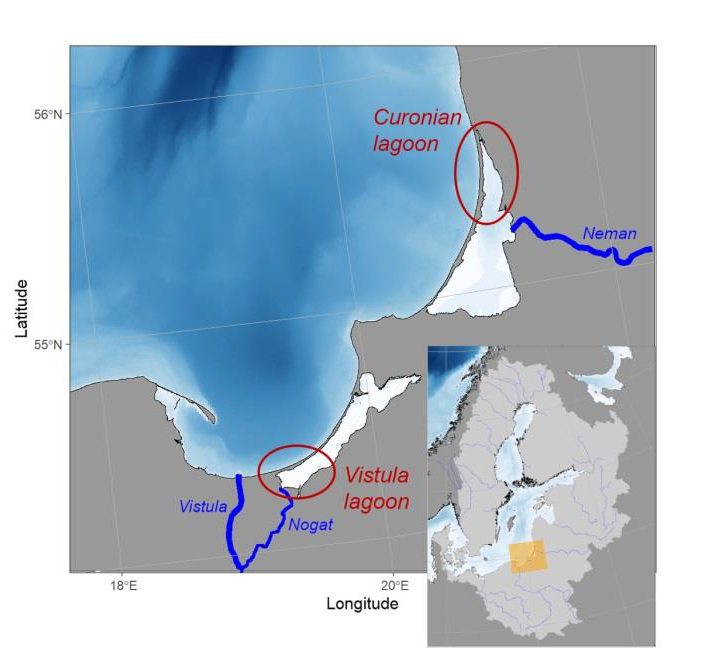 Location of the sampling sites of the Curonian Lagoon and Vistula Lagoon |
- To estimate the potential of the lagoons to gain N through internal processes including N₂ fixation and
- To track the fate of fixed N through the different dissimilatory microbial pathways (denitrification, dissimilatory nitrate reduction to ammonium [DNRA], and anammox).
- To profile taxonomic diversity and metabolic capabilities of microbiota in lagoons and its response to environmental stressors like temperature and nutrient availability.
- To assess how metabolic repertoire and activity of microbial communities affect ecosystem functions and evaluate how this is shaped by climate-driven changes.
